Common Things Every BJJ White Belt Does: The Gracie Barra Lutz Survival Guide
The white belt phase in Brazilian Jiu-Jitsu is a time of incredible discovery, physical challenge, and, quite often, total confusion. It is the stage where you are a “sponge,” soaking up every detail of the meaning of BJJ. However, because everything is new, almost every beginner falls into the same set of predictable habits. These aren’t necessarily “bad”—they are simply part of the natural learning curve that every black belt once navigated.
At Gracie Barra Lutz, we see these patterns daily. Our instructors are experts at identifying these “white belt tendencies” and helping students refine them into technical prowess. Understanding what these common habits are can help you recognize them in your own game, allowing you to progress toward your blue belt with greater awareness. Here is a breakdown of ten things every white belt does and how to transition past them.
BRAZILIAN JIU JITSU IN LUTZ
1. The Infamous “Spazzy” Movement
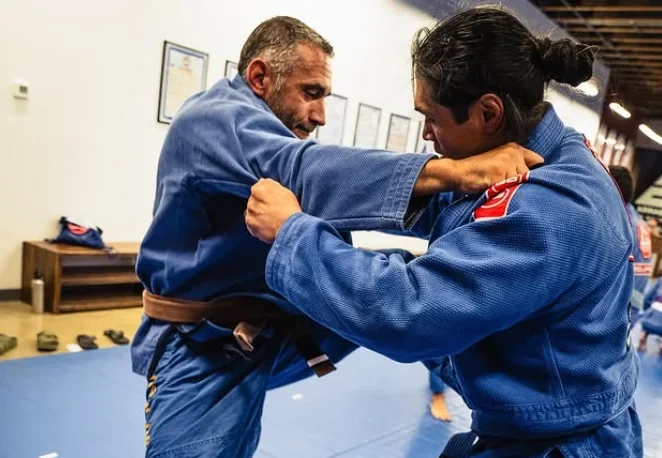
If you’ve heard the term “spazzy white belt,” it refers to the tendency of beginners to move with high intensity and zero direction. When a white belt doesn’t know what to do technically, their natural instinct is to move as fast and hard as possible in every direction.
Why it happens: It’s a survival mechanism. In a state of physical stress, the body defaults to “fight or flight.” Without a technical solution, the brain chooses “fight” by flailing limbs and exploding with energy.
The Fix: Breathe and slow down. In our adult BJJ classes in Lutz, we encourage students to pause when they are stuck. If you don’t know the move, don’t just explode—think. Controlled movement will always beat chaotic energy in the long run.
2. Using “Death Grips” on the Gi
White belts often believe that if they let go of a grip, they lose the fight. They will grab a sleeve or a collar and hold on with 100% of their strength for five minutes straight.
The Result: Within one round, their forearms are completely “gassed out,” and they can no longer close their hands. This is a classic beginner mistake.
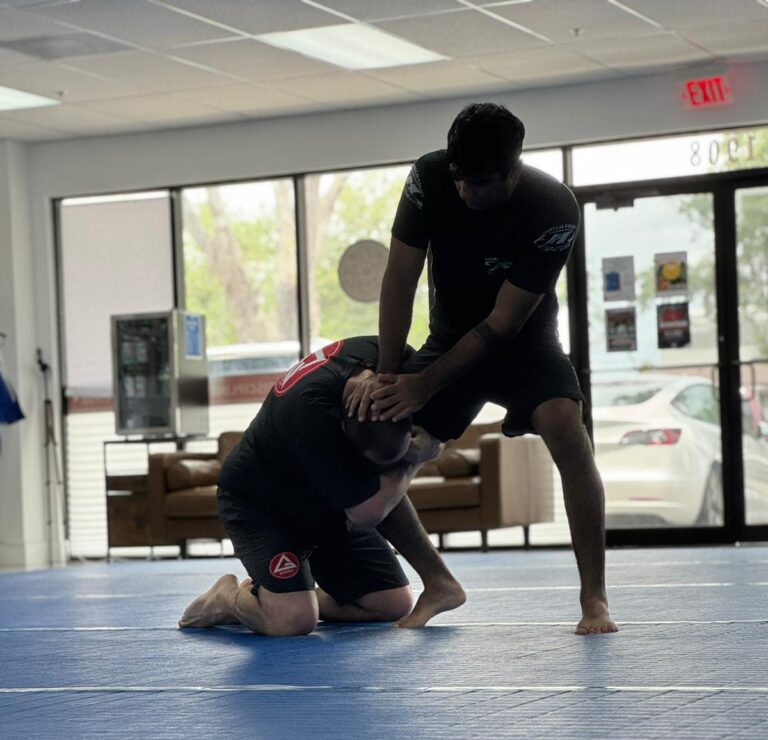
The Fix: Learn to relax your hands. You only need to grip tightly when you are actively moving or preventing a specific transition. If your partner isn’t moving, you don’t need to squeeze. This is especially true in no-gi training, where friction is your primary tool rather than fabric.
3. Holding the Breath
Watch a white belt rolling, and you will see their face turn bright red. Beginners often forget the most basic human function: breathing. They hold their breath while struggling to escape a position or while applying a submission.
The Result: They tire out in under two minutes. Oxygen is the fuel for your muscles; without it, you are running on an empty tank.
The Fix: Focus on rhythmic breathing. Try to inhale through your nose and exhale through your mouth. If you find yourself holding your breath, it’s a sign that you are using too much effort and not enough technique.
4. The “What If” Question Phase
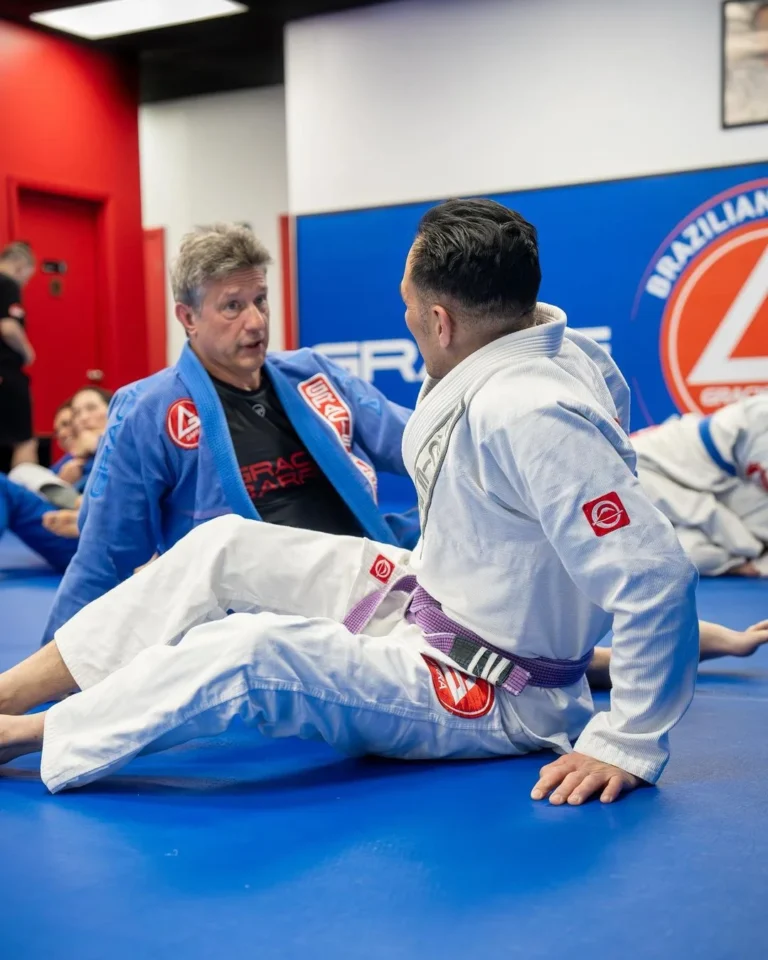
During the technical instruction portion of class at Gracie Barra Lutz, white belts are famous for asking “What if” questions. “What if he grabs my leg here?” “What if he’s much bigger than me?” “What if he does this instead?”
Why it happens: Beginners are trying to map out a massive, complex system. They want to know the answer to every possible variable.
The Fix: Focus on the technique being taught right now. BJJ is a game of infinite variables, and trying to learn them all at once is impossible. Follow the instructor’s lead and master the specific movement of the day. The answers to your “what ifs” will come naturally as your BJJ belt journey continues.
5. Trying to “Win” the Warm-up
At many Jiu Jitsu gyms in Lutz, you’ll see beginners treating the warm-up like a competition. Whether it’s shrimping across the mat or doing push-ups, they try to be the fastest or the strongest.
The Result: They are exhausted before the actual technique or sparring even begins.
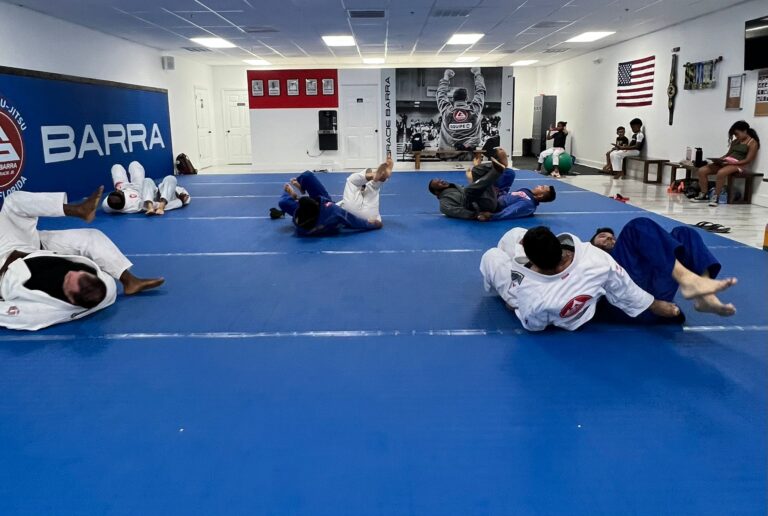
The Fix: Use the warm-up to prepare your body and master the movements. Shrimping, bridging, and rolling are fundamental BJJ movements. Doing them slowly and correctly is infinitely more valuable than doing them fast and sloppily.
6. Apologizing After Every Move
BJJ is a contact sport. You will accidentally elbow someone, sit on them, or sweat on them. White belts, especially those in our women’s BJJ program, often feel the need to apologize for every minor contact.
The Reality: Your training partners know what they signed up for. As long as you are following mat etiquette and not being intentionally reckless, there is no need to apologize for doing Jiu-Jitsu.
The Fix: A simple fist bump at the end of the roll is enough. Focus on being a good partner by being controlled and technical, rather than being overly apologetic.
7. Focusing on Submissions Over Position
A white belt will often see an arm dangling and dive for an armbar while they are still in a bad position, like being underneath their opponent’s side control.
The Result: They lose what little control they had and end up in a worse spot.
The Fix: Follow the golden rule: Position Before Submission. You must secure a dominant position (Mount, Back, Side Control) before you ever look for a finish. This is the cornerstone of the Gracie Barra philosophy taught at our Lutz academy.
8. Comparing Themselves to Others
“Why did that person get their stripe before me?” “Why can’t I beat the other white belt who started at the same time?” White belts often fall into the trap of comparing their progress to their peers.
The Reality: Everyone’s journey is different. Some people have previous wrestling experience, others have more time to train, and everyone learns at a different pace.
The Fix: Your only competition is who you were yesterday. Focus on your own growth. If you can escape a position today that you couldn’t escape last week, that is a victory. Building confidence comes from personal mastery, not from being better than the person next to you.
9. Neglecting the “Tap” (The Ego Trap)
Sometimes a white belt’s ego gets in the way, and they refuse to tap to a submission because they think they can “muscle” their way out of it.
The Danger: This is how injuries happen. A joint lock or a choke is a technical reality that strength cannot overcome.
The Fix: Tap early and tap often. Tapping is a reset button that allows you to learn from your mistake and go again. It is a vital part of the etiquette we teach in Lutz. There is no shame in tapping; it is the most honest way to learn.
10. Forgetting to Have Fun
With all the focus on technique, stripes, and self-defense, beginners sometimes forget that BJJ is supposed to be fun! They get so frustrated by their “failures” that they lose sight of the joy of the art.
The Fix: Enjoy the process. You are learning a skill that 99% of the population will never know. You are part of a supportive community at Gracie Barra Lutz. Every day on the mat is a good day.
Transitioning Beyond the White Belt in Lutz
Recognizing these habits is the first step toward overcoming them. As you become more aware of your breathing, your grips, and your ego, your Jiu-Jitsu will begin to transform. You will move from a state of “surviving” to a state of “evolving.”
BRAZILIAN JIU JITSU IN LUTZ
Our instructors at Gracie Barra Lutz are here to help you navigate these common pitfalls. We provide a structured, safe, and encouraging environment for adults, teens, and preschoolers to learn the art the right way from day one.
Are you ready to stop “spazzing” and start rolling with technique? Join our family and see why we are the premier choice for martial arts in the Lutz community.
Visit our official website to see our class schedule or to sign up for a free introductory class. Let’s start your journey toward that blue belt today!